What the housekeeper in “Rebecca” reveals about the writing process

If you read Daphne De Maurier’s Rebecca, then you know Mrs. Danvers, the mysteriously manipulative housekeeper of Manderley. What you may not know is how her character developed. It says much about the writing process.

In an interview describing the development of Mrs. Danvers, Du Maurier said, “…the housekeeper, Mrs. Danvers had become more sinister. Why I have no idea.”

Taking her at her word, I think Mrs. Danvers became more sinister in the story because writers have an instinctive sensibility for storytelling that often surprise them in the writing process. Characters simply take over no matter what the writer intends. I have no idea how Du Maurier originally envisioned Mrs. Danvers, but if she were not sinister, not a creepy manipulative, jealous, spiteful woman, there would be no tension, no conflict between her and the new Mrs. de Winter. The reader senses the conflict, more so than Mrs. de Winter.

Mrs. Danvers is the pivotal character in the story around which so much mystery revolves. Without her sinister character the story is entirely different, our feelings for Mrs. de Winter will be different, for the malevolent spirit of Mrs. Danvers will be mitigated and Mrs. de Winter will not seem so isolated, so vulnerable.

I have read about many writers, Ray Bradbury, Stephen King, and Elmore Leonard to name three, who have an idea for a story and in the course of writings, minor characters become major characters, and where the story was planned to go ends up going somewhere else. Again, it gets back to the writers instinct, the ability to sense when you come to the fork in the road, you take the one that feels right.

The lesson here is if you write, don’t think too much, just keeping clicking letters on the keyboard, use it like an Ouija board and see where the fingers take you.

Du Maurier also said, “Women want love to be a novel, men want a short story.” I’ll let you sort that one out.

Loonies_In_Hollywood-375x712coyotemoon_silentmurder (1)Cemetery_Tales_and_other_PhantasmsA-351x597


One Click In This Blog To Chill Your Halloween Bones

Okay these stories I bring you may not chill your bones, but might give pause, make you ponder-weak and weary- though some may haunt your mind. The following comes from my brief synopsis from Cemetery Tales and other Phantasms:

Tales for the darkness in your mind. Eight stories from the twilight zone of shadows, cemeteries, castles; where life and death mingle in haunting dimensions of reality and unreality, of eerie journeys, strange beginnings, strange endings, and revenge from the grave.

A man quits his job and finds himself drawn into a world that does not really exist. In another story, a young high school graduate journeys to a strange English castle. In “Due Date” a writer returns to his home town to find the young woman who inspired his writing  journey and meets her in a shadow world. The final four stories take place in a cemetery where some are dying to get in while others are dying to get out.

Here are two reviews:

“If you’re a reader who’s tired of blood and gore, or who’s never liked it, you should enjoy these suspenseful Twilight-Zone style stories. Some of them leave the reader wondering (which can be good or bad) but most are neatly tied up.” -Miss Scarlett, Amazon review.

“Eight stories with neat little Twilight Zone twists that sometimes work and sometimes don’t. My favourites were ‘Flowers For Martha Clements’, for the hauntingly melancholy vibe that sucks you into the story, and ‘Desecration’, for the fact that revenge is justly served.”-Rachel, Amazon review

2.99 click to my Amazon page for this e-Book

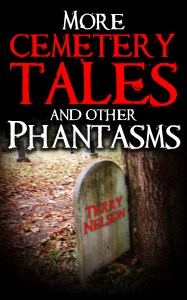
But wait says the Undertaker, there is more. This from More Cemetery Tales and Other Phantasms:

“There is a theatre that runs favorite films of every member of the audience. But the price may be high. There is a house in the woods that may or may not be haunted; it is for you to decide. There is a man walking in a cemetery who has trouble communicating with those he meets. The fourth story is my humble attempt to reimagine the ending of Mary Shelley’s “Frankenstein.” There is a crazed killer who-no, I can’t tell you. Another story is about a boy going to his first parade. Ah, how sweet. So you might think before reading this story. There is a man who wakes up and finds a dead woman in his bed and has no idea who she is. And the final story is about what happens to a writer creating stories like the previous seven, a story where some characters will be familiar.

It has not been reviewed, but feel free to do so, if reviewing doesn’t scare you that is.

2.99 click to enter Amazon and purchase these stories.

Cemetery_Tales_and_other_PhantasmsA-351x597coyotemoon_cemetaryb

Why I Celebrate Being An Indie Writer

Most writers want an agent, a three-book publishing deal, an author tour, speaking engagements, and everything in between and surrounding the dream. Few achieve it.

Assuming you get a deal, how long does it all take. I found this in a blog from Steve Laube at his agency:

“What is average?

In my experience:

From idea to book proposal to your literary agent: 1-3 months
From agent to editor and book contract offer: 2-5 months
From contract offer to first paycheck: 2-3 months
From contract to delivery of manuscript to editor: 3-9 months (sometimes longer)
(From delivery of manuscript to editor actually working on it: 2-5 months)
From editor to publication: 9-12 months

Total time from idea to print: approximately 2 years

Your mileage may vary.”

I have read similar timelines from other agents, though the two year window is more often for non-fiction, and fiction maybe a year, a year and a half. The bottom line is that is a long time, but as an Indie author, I can write and proofread and when ready I can click on the publish button on Amazon and my e-Book is ready.

Agents seem to be trained to say no. Which is a main reason best sellers so often are rejected over and over, but persistence finally found a publisher. Stephen King getting rejected with his first novel. Yes. Everyone gets rejected.

I am used to rejection. The army rejected me for flat feet. That meant I was not going to Viet Nam. Some rejections you can live with and say thank you. Others, like getting turned down for a date by that cute blonde, brunette, and the redhead is another matter. And when you pet rejects you have problems.

I can live with rejection, but I want my stories in the marketplace, I want to connect with readers sooner rather than later. Being part of the Indie Cyber world provides me more interaction and more control. I can set the price, I can control the advertising. In fact I can control everything from beginning to end.

This month Amazon is celebrating Indie authors. They have a landing page where you can explore Indie writers, so give it a try. There are many good Indie writers.

As for me, here are my indie e-books. At the top of the page you can click on titles to read more about them as well as review quotes.

dugout (1)Loonies_In_Hollywood-375x712coyotemoon_silentmurder (1)Cemetery_Tales_and_other_PhantasmsA-351x597coyotemoon_cemetaryb


Why I Created Three Fictional Characters-And How

It started so strangely.

There was a real person named Charlie Faust, 1880-1915, who once pitched for the New York Giants in 1911. Sort of.  A biography of Charlie, though much of his life is unknown, was written by Gabriel Schecter, called Victory Faust.

But who was Charlie?

That is what baseball people wanted to know. He was strange, and though many of his famous Giant teammates talked about him, and wrote about him, Charlie remains elusive. He could have been the most naïve country hick in history. Or he could have had mental issues. Perhaps-in the language of the day-retarded. But nobody knows for sure.

A few people have tried to write a fictional story of his life, but according to Mr. Schecter, nobody had. So a few years ago I decided to explore Charlie. To tell his story I used a rookie fresh off a Storden, Minnesota farm. Chet Koski was born in 1888 and in 1911 at the time of the story he is 22, his birthday being in October. He is not the rube that Charlie is, but it is his first time in a big city, and in a true sense it is his coming of age story, though by stories end, Chet does not fully bloom.

So we see Charlie through Chet who ends up as Charlie’s friend and at times guardian angel.

Now a young man in New York needs a girlfriend and she is Eveleen Sullivan, born in Ireland, 1890. Red hair, green eyes, she is all Irish. Her dreams are of the Broadway stage. When we meet her she is doing small parts, mostly in the chorus. She has another suitor, a British actor, who I will say little about. I won’t say he is a cad, but there is something about him I don’t trust.

Chet and Eveleen, like any young couple whose dreams lie in different direction, are unsure of themselves, of each other, and of any future. They might have a chance together, but then again, who knows.

The e-Novel is a satire on fame and celebrity. Charlie after all, though he is more a good luck omen, like a rabbits foot, or a horseshoe, becomes famous, not only in New York where he appears on Broadway within weeks of his mysterious arrival in New York, but all around baseball and the cities he sort of played in.

The baseball action and the scores are accurate. I researched the season and the games. Since Chet is fictional, I substituted him for a real player from time to time, but though he is fictional, what he does is what really happened.

Not only do we meet Christy Mathewson, Rube Marquard, manager John McGraw and other Giant players, we also meet Bat Masterson, George M. Cohan, and sportswriter Damon Runyon.

I said in the heading there were three fictional characters and I have mentioned only two, Chet and Eveleen. The third is Clancy. At the time of this story she is eleven years old and is not in Loonies in the Dugout. She shows up at the age of 22 in Loonies in Hollywood. She is the daughter of a rich California banker, and a carpe diem flapper with an extroverted personality. She is, as anyone would say, a handful. She was to be a plot device, nothing more; enter and leave the story in one scene, and a brief one at that. But she dominated the scene and as writers know, a character, yes a fictional one, can force their way into a story. She has become my favorite character. As I said she is a handful. 

And of course Clancy became friends with Eveleen and Chet, helping their murder investigations in two published books and one mystery in progress.

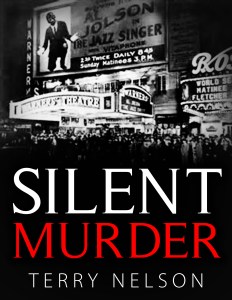
Though the three characters appear in two stories, Silent Murder being the second, you do not have to read them in sequence as each is a stand alone story.

You can find them on Amazon here. Loonies in the Dugout, with two four star reviews, only 99 cents.

dugout (1)Loonies_In_Hollywood-375x712coyotemoon_silentmurder (1)


MYSTERY OF THE WORD ‘BOOK’ AND HOW TO SAVE A BEECH TREE

I don’t know about you, but I have an interest in words. Where a particular word comes from, its origin, the root of the word, for some reason fascinates me. So I did some research wanting to know why we call a book a book.

One Internet search claims that ‘book’ is derived from the Danish word for bog, and or beech tree. Keep in mind this was a search done some while ago and I do not have the exact information, but it was Danish. Being half Danish and a writer I was proud of the Danish connection to ‘book.’ I surfed the Internet trying to find that information recently, but nothing showing the Danish connection was found, instead it was those Germanic languages taking claim.

One site said ‘book’ came from “Old English boc “book, writing, written document,” traditionally from Proto-Germanic *bokiz “beech” (cf. German Buch “book” Buche “beech;” I see the word beech, a tree, connected to the Danish origin which I had previously found. But notice it is now Germanic. Like World War 2, the Danes once again are at the mercy of those Germanic invaders from the south.

I found another site which echoed the above origin, almost word for word. But as we all know-at least I think we do-the Internet is not that reliable, and one mistake will be repeated over and over. Example: in researching a theatre, I found every website said the theatre, built in 1930, cost $200,000. I believed it, but they were wrong. I uncovered the original document which said it cost $60,000.

Now I am not saying that the origin of the word ‘book’ being Germanic is wrong, but more research needs to be done. There does seem to be an agreement that early Indo-European writings were etched on beech wood. Thus beech evolved into book, probably because of the sound of the word for beech.

Danish is a northern Germanic language-so the Internet tells me-and so I will hold out that the origin of the word ‘book’ is traced back to my Danish ancestors. The weather in Denmark is dreary most of the year, and the Danes, like Hamlet-who was based on a real Danish prince-are melancholy, so I am sure the Danes began writing and reading on beech wood because there was no television or Internet, and they needed something to do. Which is why this half-Dane wrote this blog in the first place.

No beech trees, or any type of trees, were harmed in the making of these delightful e-books that you can find here. Each book you buy saves a beech tree.


dugout (1)Loonies_In_Hollywood-375x712coyotemoon_silentmurder (1)Cemetery_Tales_and_other_PhantasmsA-351x597coyotemoon_cemetaryb

WHY I TALK TO MY BOOKS-A LAMENT

If you live long enough this will happen.

Today I have a firm handle on my remaining books. I dust them, talk to them, pet them like a cat, reorganize them on shelves. They are happy.

Why you ask do I do this?

I realized I had to do something.

I frequently go to library sales, Goodwill stores, thrift shops, and other places where books are found at cheap prices. During these expeditions I run across a book that gives me pause. I recall that I read the book years ago. I remember nothing of the story. Nothing. Then, as in the case of Robert Penn Warren for example, I recall other books of his I read. And though I recall titles, the story is lost, gone, as if never read.

Recently this happened when I found Paul Auster’s “Brooklyn Follies.” I recall reading his New York trilogy, but the stories, the characters, as elusive as the wind. What does this say about my memory? What would Marcel Proust say? Would I be a character in his seven volume opus? I think I would be more likely to end up in a Kafka novel as a comical, schizoid paranoiac character.

This happens so often two things occur to me. One is that I have read for more books than I have thought. So many stories they have disappeared from my memory; only when seeing the title, like a familiar face from the past, do I recognize it as a friend. And how many still forgotten books that I read are waiting for the title to be seen before I say, “Oh yeah, I remember reading that book.”

How, I ask myself, can a story that absorbed all my thoughts, that captured all my emotions, that engrossed my entire attention, be forgotten. How can this be? How can it be, in the end, so transitory?

The second thing is where are those books, where have they gone? I don’t remember disposing of them, not all of them anyway. Did I recycle them to second-hand stores? Did I give them to friends? Were some lost in moving? Did my mother throw them away like my baseball cards? (No!)

But still they have gone somewhere.

I wonder if being on my shelf for so long, feeling neglected, undusted, they decided to leave like a cat who thinks it is time to find a better home.

They must have snuck out in the middle of night, one here, one there, meeting up at a secret location, perhaps some used book store. A slow steady stream of books over time slinking out unnoticed.

With the story lost, they must not have had a reason to stay.

That is why I talk to my books today. I want them to stay around.

Loonies_In_Hollywood-375x712coyotemoon_silentmurder (1)coyotemoon_cemetaryb


Why was Joseph Mitchell Glad Joe Gould Did Not Get Published

Joseph Mitchell (1909-1996) was a journalist best known for his work in the New Yorker. He also published five books, one of which is “Joe Gould’s Secret.” The book is two articles about Joe Gould, one written in 1942, the second in 1964. Reading the book one realizes why Mitchell is still revered as a great writer and journalist.

He wrote about the eccentrics in New York City and Joe Gould qualifies.

Gould, Harvard educated, was a bum, living on handouts from friends, including E.E. Cummings, Ezra Pound, and other writers and artists. They all thought Joe was working on his epic oral history that he said was well over one million words.

At the risk of giving away something about the book-you should read it anyway for the great writing and the portrait of Joe Gould- Mitchell wrote the following:

“I began to feel that it was admirable that he hadn’t (author’s italics) written it. One less book to clutter up the world, one less book to take up space and catch dust and go unread from bookstores to homes, to second-hand bookstores and junk stores and thrift shops to still other homes to still other second-hand bookstores and junk stores and thrift shops to still other homes ad infinitum.”

Yes, that is the life of a book. But though I admire Mitchell, if you love books, is it not the more the merrier. Granted there are so many writers, so many books, that it can be overwhelming with choices and certainly there are undiscovered writers you feel you would love if only you could find them. But that is the joy isn’t it. The search for writers, the search for books is an expedition and I have found many treasures at second-hand bookstores, at junk stores, at yard sales, at library sales, and thrift shops.

But Joe Gould did write something, but to learn what, you must read Mitchell’s book.

Other books by Joseph Mitchell that you can learn abut at Amazon:

Up in the Old Hotel

My Ears Are Bent

McSorley’s Wonderful Saloon

The Bottom of the Harbor

Old Mr. Flood

dugout (1)Loonies_In_Hollywood-375x712coyotemoon_silentmurder


Hey Kindle Readers-Want A Free e-Book

I was going to enter Writers Digest contest for self published e-Books, but there was a $110 entry fee. What?

No thanks.

But I do have the code for the free gift, so the first person who wants the free e-Book gets it. If you have a Kindle or Kindle app (free from Amazon) just write your email address in comments so I can send you the book. I will not allow email addresses to be seen publically as I will not approve comments, thus they should not be shown.

The e-Book is Loonies in the Dugout. Click above on title for synopsis. It has 2 four star reviews. Based on a true story about Charlie Faust and the 1911 New York Giants baseball team, the book is a satire on fame and celebrity and works as both baseball fiction and literary fiction.

dugout (1)


Are These 10 Novels The Best In History-You Decide

I picked up  “The Novel 100” by Daniel S. Burt published in 2004 at a sale. I mention the date because there is a 2010 revised edition and I have not seen it, so I must stick with his 2004 list. He ranks the greatest 100 novels of all time. Like any writer of a list written by someone with integrity, Burt has the good sense to invite disagreement, going as far to say in his introduction ” If you disagree violently with some of my choices, I shall be pleased.” I advise to not get violent.

I am not going to list all 100, but stick to his top ten and give my thoughts along the way.

  1. Don Quixote by Miguel de Cervantes. Burt claims it is the second best-selling book in history. Flaubert wrote in 1852 that “What is prodigious about Don Quixote is the absence of art. . .” Flaubert is a bit enamored here. Cervantes clearly has written an artistic book. Flaubert’s comments reminds me of the novelist and Beowulf scholar, John Gardner  who told our college English class that Treasure Island (not on top 100, but Honorable Mention) was not fiction, but something  else entirely, though he could not articulate exactly what he meant. I read Don Quixote decades ago and have forgotten most of it. Certainly deserves top 100, but . . Free Kindle edition here.
  2. War and Peace by Leo Tolstoy. I recall seeing a hardback edition in my home when growing up. I don’t think anyone in the household had read it. It was thick and intimidating for me, so I stuck to The Hardy Boys.  There is a free Kindle edition here. I just clicked the fun button, so will put it in my reading list, but there are 296 books ahead of it. Must do some weeding soon.
  3. Ulysses by James Joyce. A formerly banned book makes the list. I have a vague memory of either reading a few pages of it in College or actually trying to read it, can’t recall which, but once again a free Kindle edition. It is, I am told, a difficult read, but I believe I can handle it having much reading experience since college. While it has received much praise, D.H. Lawrence, H.G. Wells, and Virginia Woolf thought the book essentially garbage. So it must be good, being controversial and all.
  4. In Search of Lost Time by Marcel Proust. This is now the preferred title to Remembrances of Things Past., at least according to Burt. I had no idea until now, so am at a loss to know who made this decision. Keep in mind it is seven volumes. Should make good winter reading. If you begin reading this after Ulysses you are a brave soul as you risk mind and memory. A 99 cent Kindle edition is worth a try
  5. The Brothers Karamazov by Fyodor Dostoevsky. Another book I have not read and the second Russian to make the list. Sigmund Freud said the book is ” the most significant novel ever written.” If you trust Freud then a free illustrated Kindle edition with one click.  I love clicking for free books, especially classics, and I have some catching up to do. I have read Crime and Punishment though, so I get some points.
  6. Moby Dick by Herman Melville. Time for a bit of a rant. I tried twice to read this book and both times got to a long non-fictional account of whaling that broke up the narrative flow, and I grew bored, then irritated, then gave up. A not needed sidebar and Melville, I believe, was getting paid by the word. Aha! I loved Melville’s short story Bartelby, but I guess I am not into whaling. But Amazon does offer a free Kindle edition.
  7. Madame Bovary by Gustave Flaubert. I read this, like Don Quixote, decades ago. I would like to read it again because I recall nothing. Burt said the book has elements that make it perhaps the first “modern novel”  but I think I read it because I heard there were some sex scenes. Were there? Or was that in the movie? No matter. If I read it again it will be for literary value. If there are some sex scenes, so much the better. Literary Free Kindle Edition.
  8. Middlemarch by George Eliot. For those who do not know this was the pen name for Mary Ann Evans. Full disclosure, I have not read the book. Most people prefer two of her other novels Adam Bede or The Mill on the Floss, neither of which I have read. I have read Jane Austen and the Bronte’s in College, so considering my now growing list of unread novels, Eliot will not get into my reading list. Nothing personal mind you. Could not find free book, but there is an illustrated Kindle for 99 cents.
  9. Magic Mountain by Thomas Mann. I have read other works by Mann, but not Magic Mountain. Once again I can not offer my opinion, not that it would matter anyway. Burt says, ” it “is the great philosophical novel of the 20th century.” I found a study guide for the book, but no Kindle edition. Don’t know why.
  10. The Tale of the Genji by Murasaki Shikibu. This is the most interesting and intriguing book on the list. In western tradition the novel is traced back to Don Quixote in the 16th century, but Tale of the Genji was written in China in the 11th century. It was written by a woman, one that little is known about, but according to Burt, “With its realistic social setting, individualized characters, and psychological richness, the Genji is deservedly considered unprecedented and the first great novel. I could not find a free edition despite it written a millennium ago and while there are Kindle versions ranging up to 20.99 their is a 99 cent Kindle edition. If this book is everything they say it is, it moves up the line in my reading bin.

Of the top ten I have read only two books, failed at one (Moby Dick) and tasted a bit of few others. Not good for a Bachelor of Arts in English Literature. But I have read 32 of the top 100. That makes me a .320 hitter, pretty good for baseball.

None of my following books made a any list, but did get some good reviews.

dugout (1)coyotemoon_silentmurder (1)Cemetery_Tales_and_other_PhantasmsA-351x597coyotemoon_cemetarybLoonies_In_Hollywood-375x712


Yearly Writing Goal 1,200,000 words!! Who can do this?

There is no way I could write 1,200,000 words a year, but according to Wikipedia, the author of the best selling Perry Mason mystery novels, Erle Stanley Gardner, 1889-1970, in his early days writing for pulp magazines had a goal of just that, 1,200,000 words a year.

TIME OUT.

Lets do some math. Feel free to double check as math is not my strong suit. Let us start with 360 writing days, taking off for Thanksgiving, Christmas, Mother’s Day, and two flex days. Dividing words by days I get 3,333 words per day. Assuming a 10-hour day that is 333 words per hour. I wonder if he kept a running total at his desk. Did he fall behind and do an extra few hours each day to catch up. There is no way he could do that today with Social Media and the Internet to distract him. Oh what a cut cat video!

Okay I can see 333 words an hour, but doing so ten hours a day, 360 days a year is obsessive compulsive; in other words, just plain nuts.

On the other hand, when Gardner started writing pulp fiction stories he would get three cents a word. If he wrote 1,200,000 words that comes out $36,000 a year which in those days was big money.

Now keep in mind Gardner wrote 82 Perry Mason novels as well as a series about a private detective agency Cool and Lam, another series about District Attorney Doug Selby, and used pseudonyms like AA Fair, Carleton Kendrake, Charles J Kenny, and  Charles M Green. He also wrote at least 205 short stories mostly for pulp fiction magazines, and in his spare time wrote non-fiction travel books.

According to Goodreads Gardner has 344 books listed. Were they counting reissues? I did not count them, and have no plans to do so as that would take up time needed to meet my writing goals; just short of 1,000,000 words. That’s for the next 10 years, fifteen if I take off holidays, Mondays and cat videos. If he did indeed write 344 books as well as short stories then perhaps he did reach his stated goal of 1,200,000.

I had hoped that reading about Gardner’s words goal I would get inspired to write more, to get me a kick in the pants. But the more I think of those ten hour days, I am already tired. I need a nap.

dugout (1)coyotemoon_silentmurder (1)coyotemoon_cemetaryb